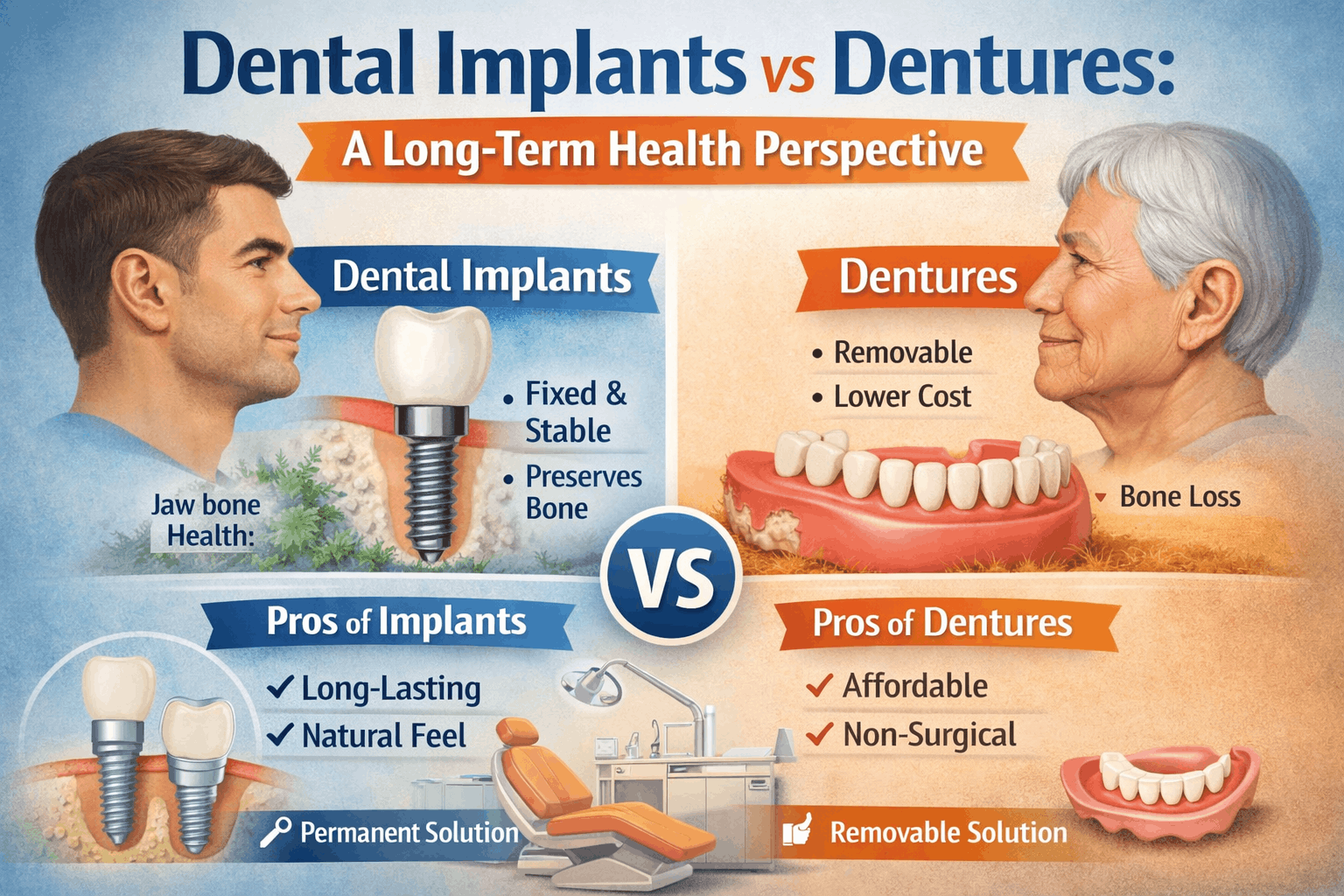
Tooth loss can affect more than the appearance of a smile. Missing teeth may reduce chewing efficiency, alter speech clarity, and gradually change the alignment of surrounding teeth. The absence of teeth gradually influences jawbone health and facial structure.
Modern dentistry provides multiple trustworthy methods for tooth replacement solutions which address the problem of missing teeth. The two most frequently used dental procedures for this purpose are dental implants and dentures. When comparing dental implants vs dentures, many patients want to understand which treatment can provide them with:
- Better stability,
- Comfort,
- Durability, and
- Better oral health over time.
Patients can make decisions that positively impact their smile through their understanding of treatment advantages and disadvantages, which stem from their specific medical conditions. The treatment options present help patients understand them in order to make informed decisions about their dental needs.
Why Tooth Replacement Matters
According to dentists, patients should get dental implants to replace missing teeth without delay. The adjacent teeth begin shifting into the vacant space, which occurs after tooth extraction. This particular movement can cause bite problems, which lead to uneven tooth wear, gum irritation, and various dental issues.
Jawbone health stands as another significant issue to consider. The jawbone receives stimulation through natural tooth roots during the process of chewing. The missing tooth prevents the surrounding area from receiving necessary stimulation. The jawbone undergoes gradual shrinkage through the process of bone resorption, which occurs when the body loses this stimulation.
Bone loss results in changes to facial appearance, making it difficult to perform dental work at a later time. The process of replacing missing teeth helps to recreate proper mouth function while restoring mouth equilibrium.
What Are Dental Implants?
Dental implants serve as synthetic tooth roots, which dentists construct using medical-grade titanium materials. The dentist performs a surgical procedure to insert the implant into the patient’s jawbone. This will later bond with the bone through osseointegration.
Healing leads to the attachment of a custom restoration. This includes a crown bridge or full-arch prosthesis to the implant. The tooth replacement procedure results in a prosthetic tooth that completely matches the functional and visual characteristics of a natural tooth.
The restorative dentistry procedure allows dentists to use dental implants as a method for constructing essential structural components needed to perform dental treatments. The dental implants bond with the jawbone, enabling even distribution of chewing forces to all areas of the mouth. Dental implant users maintain their artificial teeth in a stable position, which creates a natural sensation that resembles real teeth.
Many patients researching dental implants in Canada consider them a long-term solution. This is because they can last many years when properly maintained with regular dental care.
What Are Dentures?
Dentures are removable devices. They are designed to replace missing teeth and surrounding gum tissue. They are usually made from acrylic materials and include metal frameworks to improve support.
Dentures generally fall into two categories:
- Complete dentures: They replace all teeth in the upper or lower jaw.
- Partial dentures: They replace several missing teeth, while remaining natural teeth provide support.
Unlike dental implants, dentures rest on the gum tissue rather than being anchored in the jawbone. They restore the appearance of a full smile. They also allow patients to chew and speak more comfortably after tooth loss.
Dentures remain a widely used treatment option. They are particularly suitable for individuals missing many teeth or those seeking a removable and non-surgical approach to tooth replacement.
Dental Implants versus Dentures: Key Differences
The major difference between dental implants and dentures is the method employed to hold them in place.
The surgical method entails the installation of dental implants directly into the jawbone. Dental implants are artificial roots for teeth. The method of integration provides stability while at the same time preserving bone density over the years. Dentures, on the contrary, are positioned atop the gums and are retained through suction, clasps, and adhesive.
The physical variation makes dental implants more effective in providing stability and performance during meals. Dentures, however, are still effective in replacing teeth, especially for individuals looking for non-surgical procedures.
| Feature | Dental Implants | Dentures |
| Placement | Surgically placed in the jawbone | Rest on gums |
| Stability | Fixed and stable | Removable |
| Jawbone health | Helps preserve bone | Bone loss may continue |
| Longevity | Often 15–25+ years | Usually 5–10 years |
| Maintenance | Similar to natural teeth | Require removal and cleaning |
| Initial cost | Higher | Lower |
The comparison highlights the reasons why dentists recommend dental implants to individuals with strong bone structures and healthy teeth.
Pros and Cons of Dental Implants
Understanding the pros and cons of dental implants can help patients decide whether they are an appropriate treatment option.
Advantages
1. Strong stability
The implants are anchored in the jawbone. This prevents slipping or movement while eating or speaking.
2. Bone preservation
They help in preserving bone density once a person has experienced tooth loss, as they serve as natural tooth roots.
3. Long-term durability
With proper oral hygiene and regular dental checkups, implants remain functional for many years.
4. Natural function
Patients chew most foods comfortably with implant-supported restorations.
Limitations
1. Higher initial cost
Implant treatment involves surgery and custom restorations. This increases the upfront investment.
2. Healing period required
There is a need for the jawbone to integrate with the implant before the final restoration takes place.
3. Not suitable for every patient
There are three factors that a dentist has to consider before he can recommend dental implants as a treatment option for a patient. These factors are the density of the patient’s bones, the condition of the patient’s gums, and the patient’s complete medical history.
Pros and Cons of Dentures
Dentures still play an important role in restorative dentistry. Let’s now discuss the pros and cons.
Advantages
1. Lower upfront cost
Dentures generally require a smaller initial investment compared with implant treatment.
2. Non-surgical solution
They can be fabricated without surgical procedures.
3. Relatively quick treatment
In many cases, dentures can be completed within a few weeks.
Limitations
1. Reduced stability
Dentures may move or shift slightly while eating or speaking, particularly as the shape of the jaw changes.
2. Ongoing bone changes
Since dentures rest on the gums, they do not prevent gradual jawbone shrinkage.
3. Maintenance and adjustments
Dentures may require relining or replacement as the mouth changes over time.
What Are Implant Dentures?
Implant-supported dentures combine elements of both treatments. What generally happens in this treatment is a denture being secured to several dental implants placed in the jawbone.
The implants function as anchoring elements. The system uses these devices to maintain dental prosthesis stability, which decreases motion during eating and speaking activities. The option uses implants to create jawbone stimulation, decreasing bone deterioration at a slower rate than standard dentures.
Patients who need more dental stability than removable dentures provide but do not need complete individual implants should receive implant-supported dentures as their recommended treatment.
Cost Comparison: Dental Implants vs Dentures
Cost is one of the most common considerations when choosing a tooth replacement option.
Dental implants generally require more initial expenses because their installation requires surgical procedures and the creation of personalized dental devices. In Canada, the price for a single implant restoration ranges between $3,000–$6,000 per tooth, depending on the complexity of treatment.
Traditional dentures typically cost less initially. Complete dentures may range from $1,000–$4,000 per arch.
Dentures need less money for their first purchase, but dental implants provide extended service life and require fewer replacement costs throughout their usage.
Ideal Candidates for Dental Implants
Dental implants may be recommended for patients who:
- Have sufficient jawbone density
- Maintain good oral hygiene habits
- Want a long-term, fixed tooth replacement
- Prefer a solution that closely mimics natural teeth
A dental examination and imaging tests are usually required to determine whether the jawbone can support implant placement.
Dentures: Who Should Consider Them
Dentures may be a suitable option for patients who:
- Are missing many or all teeth
- Prefer a removable solution
- Wish to avoid surgical procedures
- Are seeking a lower initial treatment cost
In some cases, dentists may recommend dentures as an initial solution before considering implant-supported options later.
Dental implants vs dentures: What’s the Better Choice?
Dental implants are often considered the preferred option for long-term oral health because they replace the tooth root, help preserve jawbone density, and provide strong stability. However, dentures remain an effective and widely used treatment for restoring missing teeth.
The best option depends on factors such as oral health, bone density, treatment goals, and budget. A professional dental evaluation can help determine which solution is most appropriate for each patient.
Key Takeaways
- Dental implants replace both the tooth and its root, helping maintain jawbone health.
- Dentures replace missing teeth but do not stimulate the jawbone.
- Implants typically last longer and provide greater stability when chewing.
- Dentures are removable and usually involve a lower initial cost.
- Implant-supported dentures combine the benefits of implants and traditional dentures.
FAQs
Do dental implants hurt?
Dental implants usually do not hurt during the procedure because dentists use local anesthesia to numb the area. Most patients feel little to no pain while the implant is placed. After the procedure, mild soreness, swelling, or discomfort may occur for a few days, but it typically improves quickly with prescribed or over-the-counter pain medication.
What are the 3 types of dental implants?
The three main types of dental implants are endosteal, subperiosteal, and zygomatic implants. Endosteal implants are the most common and are placed directly into the jawbone. Subperiosteal implants sit on top of the jawbone beneath the gum tissue. Zygomatic implants are anchored in the cheekbone and are usually used when the upper jawbone lacks sufficient density.
How do dental implants work?
Dental implants work by replacing the root of a missing tooth with a titanium post that is surgically placed in the jawbone. Over time, the bone bonds with the implant through a process called osseointegration. Once healing is complete, a connector and a custom crown are attached, restoring the appearance and function of the missing tooth.
How long does a dental implant take?
The dental implant process usually takes about 3 to 6 months from start to finish. After the implant is placed in the jawbone, the bone needs time to heal and integrate with the implant. Once this healing period is complete, the dentist attaches an abutment and places the final crown or restoration.
Which is better, dentures or dental implants?
Dental implants are often considered better for long-term oral health because they provide strong stability and help preserve jawbone density. Dentures are removable appliances that replace missing teeth and are usually more affordable initially. The best option depends on factors such as jawbone health, budget, and whether a patient prefers a fixed or removable solution.